Overview
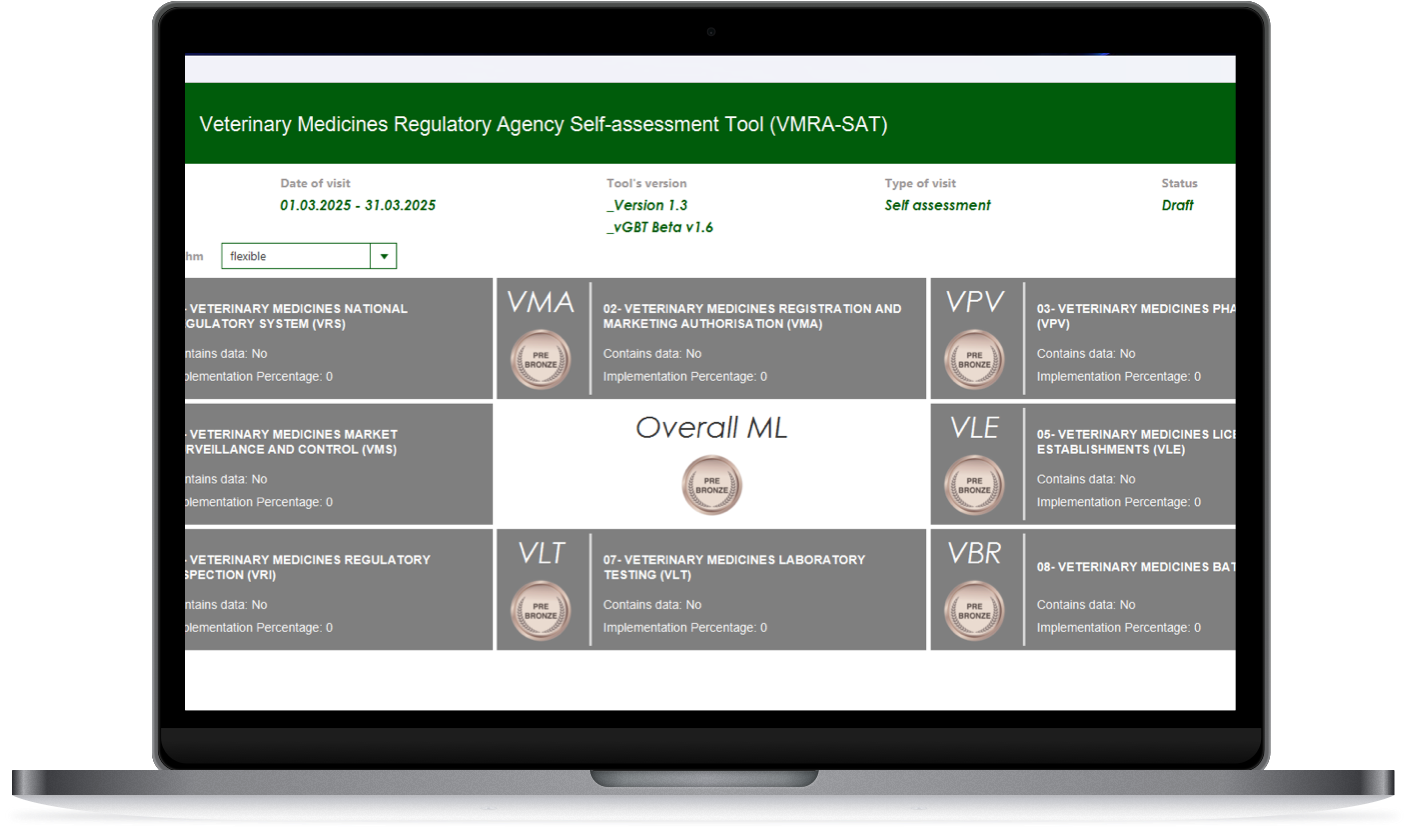
The Veterinary Medicines Regulatory Agency Self-Assessment Tool (VMRA-SAT)
The Veterinary Medicines Regulatory Agency Self-Assessment Tool (VMRA-SAT) is a structured, globally applicable diagnostic instrument designed specifically for national authorities responsible for regulating veterinary medicinal products.
Its primary purpose is to help regulators systematically evaluate the performance and maturity of their veterinary medicines regulatory systems through a self-led, evidence-based process.
VMRA-SAT is explicitly designed to be country-owned, voluntary and focused on learning and continuous improvement.
Inside the Tool
The video animation below shows the VMRA-SAT desktop software, which is the full version of the tool used by regulatory authorities to undertake a structured self-assessment of their veterinary medicines regulatory systems.
How it works
The VMRA-SAT assesses the implementation of all core regulatory functions involved in the veterinary medicines lifecycle, including:
- governance and legal foundations
- registration and marketing authorisation
- manufacturing oversight
- distribution controls
- pharmacovigilance
- inspection
- laboratory testing
- enforcement
By encompassing these functions within a single framework, VMRA-SAT provides a holistic view of how the regulatory systems operate in practice, highlighting interdependencies and areas where weaknesses in one function may undermine others.
The VMRA-SAT uses clear indicators and structured guidance to support consistent interpretation across countries and users. This helps regulators to move beyond informal, reactive self-reflection to a more systematic understanding of regulatory performance.
The structured design of the tool enables effective dialogue across the departments and organisations involved in implementing the national veterinary medicines regulatory framework. It promotes organisational alignment, strengthens institutional memory, and helps address challenges arising from fragmented documentation and inconsistent application of processes.
VMRA-SAT is available as the Full Version (Desktop) and as the Lite Web Version (WebApp). You can read about the two versions here.
VMRA-SAT Versions »
The VMRA-SAT structure
VMRA-SAT uses a clear and structured assessment hierarchy based on functions, indicators and sub-indicators.
VMRA-SAT uses a clear assessment structure that moves from broad regulatory responsibilities to detailed requirements. It is organised into Functions, Indicators and Sub-indicators, allowing a national regulatory authority to examine both its overall regulatory system and the individual arrangements that support it. This structure helps users identify strengths, recognise gaps and understand where improvement may be needed.
Functions
The eight functions represent the main responsibilities involved in regulating veterinary medicines. They cover the national regulatory system, registration and marketing authorisation, pharmacovigilance, market surveillance and control, licensing of establishments, regulatory inspection, laboratory testing and batch release. Together, they provide a comprehensive view of the veterinary medicines regulatory system.
Indicators
Each Function is divided into indicators. Indicators describe the main elements that should be in place for a regulatory responsibility to operate effectively. These may relate to areas such as legislation, governance, leadership, quality management, human resources, procedures, infrastructure, transparency and monitoring of performance. There are 13 indicators in total, and not all are included in every function.
Sub-indicators
Indicators are assessed through more detailed sub-indicators. Each of the 235 sub-indicators describes a specific requirement or practice that can be examined during the assessment. Users consider whether the requirement has been implemented and record the information and evidence supporting their judgement.
Each sub-indicator is supported by a Fact Sheet containing information such as its purpose, requirements, suggested evidence, references, assessment criteria and relevant limitations or explanatory notes. This guidance helps users interpret the requirements consistently and base their assessment on verifiable information.
Maturity Levels
Every sub-indicator is assigned to one of five maturity levels. These levels provide a pathway showing how a regulatory system can develop from basic operating arrangements towards more advanced and integrated performance.
Pre-bronze represents the minimum operating capability and the essential foundations needed for a regulatory system to function.
Bronze indicates that elements of a regulatory system exist beyond the minimum foundations.
Silver represents an evolving system that is able to perform essential regulatory functions.
Gold represents a stable, well-functioning and integrated regulatory system.
Gold-plus represents an advanced level of regulatory performance and continuous improvement.
The levels are progressive. Requirements assigned to the earlier levels establish the foundations needed to support the more advanced requirements at later levels. They help an authority understand its current position, establish realistic priorities and monitor regulatory improvement over time.
VMRA-SAT framework
The eight regulatory functions in the VMRA-SAT
Click a card to open the relevant fact sheet in a new tab